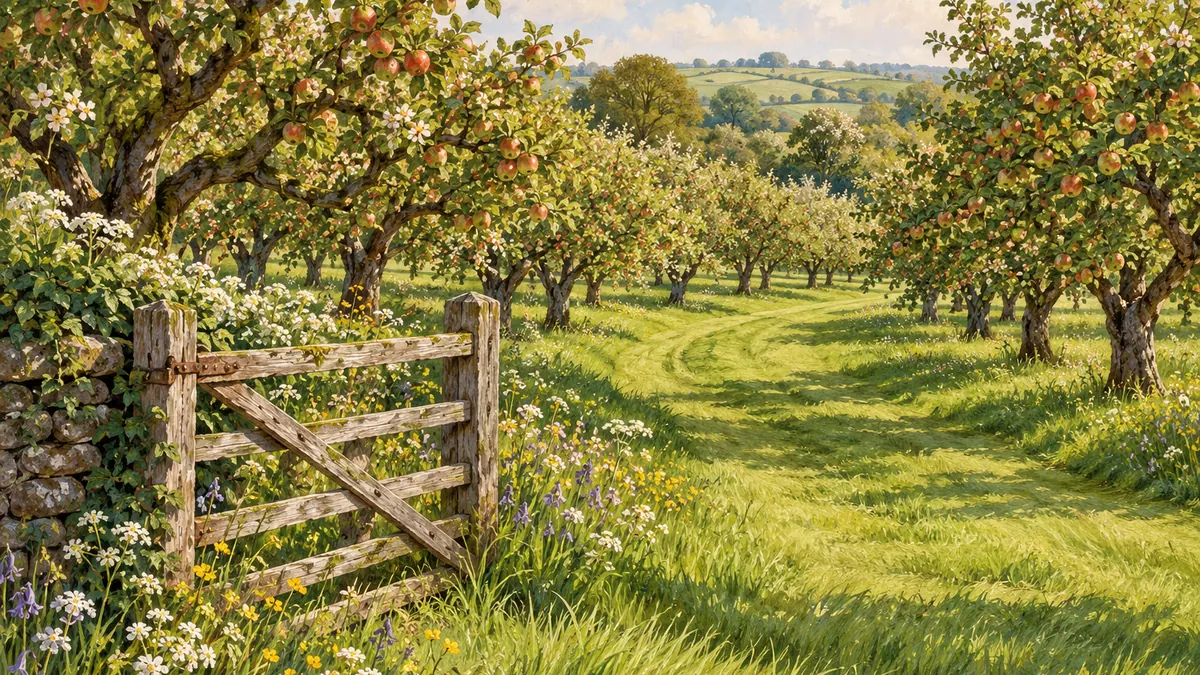
Draw the orchard as a working space
Mark rows, individual trees, gates and places where a turn is needed. Include low branches, guards, irrigation equipment and other obstacles. An orchard is not simply a rectangular grass area with its acreage reduced by a few trunks.
Record the spaces available to the complete machine and attachment, not only the width between tree centres. Ask a competent supplier to assess the route and operating suitability.
Separate between-row and around-tree work
The equipment that suits the larger open spaces may not suit the area immediately around trees. Describe those tasks separately and decide how each will be managed. Do not compensate for poor access by approaching a tree or guard with an unsuitable machine.
Ask about the potential effect of the proposed method on trunks, roots, guards and other installations. Keep tree-management advice distinct from the machine's operating instructions.
Allow for a changing orchard
Trees and planting schemes change over time. Update the route map after new planting, guard changes or other alterations. Record obstacles that are easy to overlook when vegetation grows.
Consider storage and the path from the shed to the orchard as part of the same route. A machine that can work between rows still needs to reach them without an improvised manoeuvre.
Compare the whole maintenance plan
Ask a supplier or contractor which areas their proposal covers and which remain separate work. Include the time and equipment needed for those remaining areas in the comparison. Avoid declaring a system efficient based only on its widest straight run.
Follow the manufacturer's instructions and arrange suitable competence. See HSE's guidance for machinery and hand tools for broader context.
Keep a simple seasonal note
After work, record awkward areas, damage avoided or observed, and route changes needed. Use the evidence to improve the next plan. The objective is a repeatable route that respects the actual orchard, not forcing the orchard to behave like an open paddock.